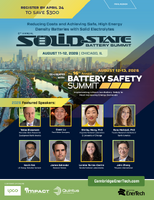
演讲嘉宾
Filter by:

Bhaskara Boddakayala, Global Technical Expert, Battery Safety & Materials, Cell Vent Management, Ford Motor Company
Bhaskara Boddakayala is an accomplished engineering professional currently serving as a Global Technical Expert in Battery Safety and Materials at Ford Motor Company. His academic foundation includes a BS in Mechanical Engineering and a Masters in Plastics Engineering, which was later complemented by an MS in Electric Vehicle Engineering from Wayne State University in Detroit. Bhaskara began his career spending five years as a Tooling and Fluid Dynamics Engineer (1995-2000) before transitioning into specialized fluid dynamics and analysis for turbochargers, charge air coolers, and induction systems between 2001 and 2009. Since 2009, Bhaskara has focused extensively on high-voltage battery systems for electric vehicles, holding various roles in battery cooling, cell integration, validation, and safety (2009-2023). Today, he leverages these 30 years of technical leadership to drive global innovations in battery safety and material performance for the next generation of electric vehicles."

Paul V. Braun, PhD, Professor & Grainger Distinguished Chair, Engineering, University of Illinois Urbana Champaign
Prof. Paul V. Braun is the Director of the Materials Research Laboratory, the Grainger Distinguished Chair in Engineering, and Professor of Materials Science and Engineering, Chemistry, Mechanical Sciences and Engineering, and Chemical and Biomolecular Engineering at the University of Illinois Urbana-Champaign. Prof. Braun received his B.S. degree with distinction from Cornell University, and his Ph.D. in Materials Science and Engineering from the University of Illinois Urbana-Champaign. Following a postdoctoral appointment at Bell Labs, Lucent Technologies, Prof. Braun joined the faculty of the University of Illinois Urbana-Champaign. Prof. Braun has co-authored a book, about 350 peer-reviewed publications, been awarded multiple patents, and has co-founded four companies. He was a member of the 2010-2011 DARPA Defense Science Study Group, and the 2015-2017 National Academies Technical Advisory Board for the US Army Research Laboratory. Prof. Braun is a Fellow of the Materials Research Society, AAAS, the National Academy of Inventors, and the American Academy of Arts and Sciences.

Benjamin Christian, New Product Development Engineer, Freudenberg-NOK Sealing Technologies
Ben has over fifteen years' experience between General Motors, XALT Energy, and now Freudenberg Sealing Technologies as an innovator and Technical Specialist in the battery industry, specializing in cell materials, pack design, and validation. With deep expertise in system architecture, virtual analysis, and high-voltage safety, he has led numerous innovations to develop new products, streamline validation costs and timing, and improve safety across the industry. Ben earned his MS in Energy Systems Engineering from the University of Michigan and BS in Manufacturing Engineering from Ferris State University.

Adam Cohn, PhD, Principal Scientist, Materials Science and Electrochemistry, Exponent, Inc.
Adam Cohn is a materials scientist specializing in battery technology. At Exponent, he supports clients across a wide range of battery-related projects, including failure analysis, cell and pack quality evaluations, intellectual property litigation, cycling studies, customized abuse testing, product recalls, and technology due diligence. Prior to joining Exponent, his research was focused on material selection, synthesis, and characterization for new battery chemistries, including sodium-ion and sodium metal systems, as an NSF fellow at Vanderbilt University.

Eric Darcy, PhD, former Battery Technical Discipline Lead, NASA-JSC; Private Consultant, Darcy Batt Consulting, LLC
Eric C. Darcy, PhD, recently finished his 38-year career at NASA in the areas of battery design, verification, and safety assessments for the rigors of manned spacecraft applications. As Battery Technical Discipline Lead at NASA-JSC, his main objective has been the development of safe, while high-performing, battery systems with a deep focus on understanding, preventing, and mitigating latent defects that could lead to catastrophic cell internal short circuits. Now he is a private consultant.

Mickael Dollé, PhD, Professor, Department of Chemistry, Université de Montréal
Mickael Dollé is a Full Professor in the Department of Chemistry at the Université de Montréal. He earned his Ph.D. from Université Picardie Jules Verne (Amiens - France) in 2002. Prior to joining Université de Montréal in 2014, he was a CNRS researcher in France after being postdoctoral fellows at Lawrence Berkeley National Laboratory and Max Planck Institute of Stuttgart. He is the recipient of the American Ceramic Society Global Star Award. His research focuses on materials chemistry, energy storage, and manufacturing. His ongoing projects focus on solid state batteries (ceramic and polymer), dry electrode processing and battery recycling.
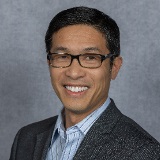
Kevin Fok, Director of Compliance, LG Energy Solution Vertech, Inc.
Kevin Fok is the Director of Compliance at LG Energy Solution Vertech, where he leads company-wide strategy for battery energy storage system (BESS) compliance. A recognized authority in the field, Kevin is deeply involved in shaping the industry’s future through his work on several key technical committees, including NFPA 855, UL 9540, and UL 1973. His leadership is backed by extensive in-the-field experience across sales, engineering, project management, and operations & maintenance. Notably, Kevin served as the onsite project manager for an award-winning, landmark BESS installation that, at the time of commissioning, was the largest in North America and featured on NOVA and PBS News Hour. With a career spanning renewable energy sectors, including nickel-metal hydride batteries, hydrogen fuel cells, and solar PV, Kevin provides a rare blend of technical expertise and business acumen. A prolific industry voice, he has contributed to over 120 conferences as a speaker and moderator. Kevin is also a co-inventor on 13 U.S. patents and holds an MBA and a B.S. in Chemical Engineering from the University of Michigan, Ann Arbor. Kevin remains committed to the next generation of leaders through active mentorship within the University of Michigan College of Engineering and Ross School of Business.

Judy Jeevarajan, PhD, Vice President and Executive Director, Electrochemical Safety Research Institute, UL Research Institutes
Dr. Judy Jeevarajan is the Vice President and Executive Director for the Electrochemical Safety Research Institute (ESRI) at UL Research Institutes (ULRI). With more than 27 years of experience in the area of batteries and a primary focus on the lithium-ion chemistry, she specializes in battery safety research, including safety trends in aged lithium-ion cells and modules, thermal runaway propagation in lithium battery systems, characterizing fire and fire suppressants for lithium-ion batteries, and consumer battery safety. Dr. Jeevarajan serves in the Technical Working Group for standards organizations such as UL Standards & Engagement (ULSE), Society of Automotive Engineers (SAE), International Civil Aviation Organization (ICAO)/Society of Aerospace Engineers (SAE), International Electrotechnical Commission (IEC), and American National Standards Institute (ANSI). From 1998 until 2003, Dr. Jeevarajan worked for Lockheed Martin Space Operations at the National Aeronautics and Space Administration (NASA) Johnson Space Center (JSC) in Houston, Texas. In 2003, she started her work as a NASA civil servant, serving as the Group Lead for Battery Safety and Advanced Technology. Dr. Jeevarajan has several awards to her credit, including the noteworthy NASA Exceptional Service Medal and NASA-NESC Engineering Excellence Award. She has been an active advocate of battery safety at meetings and conferences. She has also authored or co-authored several book chapters, including the “Battery Safety” chapter in Elsevier’s publication titled “Safety Design for Space Systems” in March 2009 (first edition) and July 2023 (second edition), and the “Managing of Risk by Manufacturers of Consumer Equipment” chapter in Elsevier’s “Electrochemical Power Sources: Fundamentals, Systems, and Applications” in September 2018. She continues to contribute to many journal publications and articles. She earned her Ph.D. in Chemistry (Electrochemistry) from the University of Alabama in Tuscaloosa (1995) and holds a Master of Science in Chemistry from the University of Notre Dame (1991).
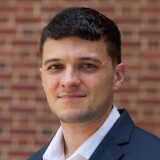
Nathan Johnson, PhD, Senior Member of Technical Staff, Sandia National Laboratories
Dr. Nathan B. Johnson completed his Doctorate in Chemical Engineering under Dr. Paul Albertus at University of Maryland, College Park in Spring 2023, and his Postdoc at Sandia National Laboratories under Dr. Loraine Torres-Castro and Dr. Alex M. Bates in January 2025. Since then, he has worked as a Senior Member of Technical Staff at Sandia National Laboratories in the Power Sources R&D organization. For the last 7 years, he has worked on safety, reliability, and diagnostics for a wide variety of primary and rechargeable battery chemistries from the materials-scale up to the pack-level. His primary focus is developing a predictive battery safety testing method through coupling materials-scale tests with numerical modeling.

Alex Kosyakov, Co-Founder & CEO, Natrion Inc.
Alex Kosyakov is the Co-Founder and CEO of Natrion, a battery technology company based in Champaign, IL and Binghamton, NY. Kosyakov studied materials science at the University of Illinois and City College of New York (CCNY). His research has primarily concentrated on reinforced polymer composites and active materials for rechargeable lithium and sodium batteries. Natrion was started in 2018 to commercialize intellectual property developed by Kosyakov and collaborators at CCNY. The company now provides Li-metal battery technologies to automotive, defense, aerospace, and consumer electronics OEMs around the world.
.tmb-0.jpg)
Masatsugu Morimitsu, Dr.Eng., Professor, Department of Science of Environment and Mathematical Modeling, Doshisha University; CTO, HEW NEXUS Co., Ltd.
Masatsugu Morimitsu is a professor of the Department of Science of Environment and Mathematical Modeling of Graduate School at Doshisha University, Japan. He obtained his B.Eng., M.Eng., and Dr. Eng. degrees from the Department of Materials Science of Kyushu Institute of Technology, Japan. His independent research group focuses on the electrochemistry and materials of novel aqueous rechargeable batteries beyond LIB for stationary energy storage and EVs.

Sahil Nagpal, HV Battery CVM Systems Engineer, Ford Motor Company
Sahil is currently serving as a Senior High Voltage Battery CVM Systems Engineer at Ford Motor Company. In this role, Sahil leads critical efforts in the domain of electric vehicle safety, specifically focusing on developing and implementing thermal runaway mitigation and cell vent management strategies. Sahil holds a Bachelor of Science degree in Mechanical Engineering (2012) and a Master of Science degree in Automotive Systems Engineering (2016). With over 12 year of experience, Sahil's career has been dedicated to the evolution of vehicle electrification. Sahil has held multiple pivotal roles at Ford dedicated to Electric vehicle Energy Analysis, CAE simulation for electric vehicles range & performance and High Voltage System Integration. Currently, he combines a strong systems-level perspective with deep technical knowledge to lead the efforts towards modern electric vehicle battery safety architectures.


Yatish Patel, PhD, Fellow, Mechanical Engineering, Imperial College London
Dr Yatish Patel is an Advanced Research Fellow in the Department of Mechanical Engineering at Imperial College London. Having trained as a physicist before moving to engineering, his research is based around developing engineering solutions centred around scientific understanding. Having authored over 60 articles his research interests spans battery degradation, electrochemical behaviour and saftey.

Tanveer Pathan, PhD, Principal Engineer, University of Warwick
Tanveer Pathan is an electrochemical engineer with nearing a decade of R&D experience in the field of electrochemistry, electrochemical power devices, and surface engineering. The last six years of his career have been focussed on lithium-ion batteries (LIBs) to study the capacity retention in LIBs. In the past, he has worked on fuel cells, electrochemistry of corrosion and corrosion analysis, functional coatings for corrosion protection, and development of metal and graphene-based electrodes for fuel cells. Currently, he is the technical lead within the Forensic Analysis of Batteries Group at WMG, University of Warwick; covering both academic and industrial projects focusing on battery forensics and understanding the degradation mechanisms in lithium-ion batteries.

James Salvador, Staff Researcher, Chemical Sciences & Materials Systems Laboratory, General Motors
Jim Salvador has worked at General Motors Research and Development for 16 years. During that time, he has led projects focused on solid state energy conversion technology for waste heat recuperation, solid state hydrogen storge materials fuel cell vehicles, low-cost permanent magnetic materials development. More recently he has worked on solid state batteries as well as fundamental understandings of thermal runaway initiation.

Tanvir Tanim, Battery R&D Engineer and Group Lead, Energy Storage Technology Group, Idaho National Laboratory
Tanvir R. Tanim is an R&D engineer and the group lead for the Energy Storage Technology Group in the Energy Storage and Advanced Transportation Department at the Idaho National Laboratory. His research focuses on enabling next-generation high-energy and power lithium-ion batteries, developing advanced algorithms for reliable life estimation, and expanding and/or verifying advanced diagnostics and prognostics of these high energy and power batteries for electric vehicle applications. Between 2014 and 2021, he authored or co-authored 25 peer-reviewed scientific articles and patents. Tanim can be reached by email at tanvir.tanim@inl.gov

Loraine Torres-Castro, PhD, Battery Safety Lead, Sandia National Laboratories
Loraine Torres-Castro is the battery safety lead for vehicle electrification and grid energy storage at Sandia National Labs. The research that Loraine oversees focuses on evaluating batteries well outside of manufacturer recommended specifications and the severity of any catastrophic thermal runaway. In the Battery Abuse Testing Laboratory, her efforts are focused on understanding the mechanisms that lead to energy storage system safety incidents, and developing mitigation strategies for single-cell and system failures. Loraine has innovated abuse testing by targeting problems using a predictive approach (early detection for intervention) to eliminate failure rather than reacting to it. Her work has led to developments in advanced abuse testing, including a fundamental understanding of cell failure, to facilitate the design of safer energy storage systems. Her expertise and commitment to safety science have led to multiple cross-collaborations among sponsoring organizations, including the Department of Energy (Office of Electricity, the Vehicle Technologies Office, Advanced Research Projects Agency-Energy), Department of Transportation, and NASA. On behalf of the Vehicle Technologies Office, she authored and maintains the US Advanced Battery Consortium (USABC) Battery Abuse Testing Manual, widely used by car manufacturers to evaluate new technologies. Loraine is also a member of the USABC, for which she provides technical advice and recommendations.

John Zhang, PhD, CTO/CSO, Polypore International
John is the CTO/CSO of Polypore International (Celgard)/Asahi Kasei. He received prestigious NAATBatt Lifetime Achievement Award 2026 along with previous awardees -- J. GOodenough (Nobel), S. Wittingham (Nobel), A. Yaoshino (Nobel) and Robin Zeng (Founder of CATL); and IBA (International Battery Association) Technology Award 2024 for his significant contribution to battery safety, battery safety standards (IEEE P1625 and P1725), invention of Ceramic Coated Separator and Outstanding Contribution in Understanding of Internal Shorts Events of Li-ion Cells that lead the broad application of Ceramic Coated Separator (CCS). This technology has made a significant contribution to the evolution of humanity (SVP/CTO Panasonic). The CCS also setup the foundations for modern success of Semi-sold state electrolyte batteries. He is recognized as the leading authority on lithium-ion battery safety and separators. John pioneered the Sulfide SSE with ~ 40 papers (1984-1991) realized S to replace O to enhance ionic conductions the necessity of 3D SSE ionic conduction for ionic interface with cathode and using I to stabilize anode vol change space. He has chaired and/or organized more than 60 international conferences and delivered more than 120 invited keynote or plenary speeches at various international conferences. John has more than 300 Publications, hold more than 260 patents, and 4 book book chapters. John received his Ph.D. from the University of California, Santa Barbara. He also attended Sloan School of MIT.
On-Demand only通行證依然持續接受申請。
請透過以下詢問按鍵與我們聯絡。


Arrive Early and Attend: